AI generated samples and Made with AI labels

And how Drake’s diss track ties into it all
Source

This essay and all new writing is also published in my newsletter which you can sign up for here.

Throughout history, artists have consistently experimented with and pushed the boundaries of what is possible with new technologies in ways that further society’s collective understanding of a technology’s capabilities and use cases. The tinkering of early animators like John Whitney laid the groundwork for the computer graphics and animation industry. More recently, artists like Holly Herndon have experimented with the use of AI voice cloning to allow anyone to generate music with an artist’s voice prompting the public to critically consider artist likeness and content provenance in a world where AI tools can cheaply generate content in the likeness of any artist. Herndon’s work felt particularly prescient earlier this month as a new Drake song sent hip hop communities into a frenzy with its use of AI voice cloning.

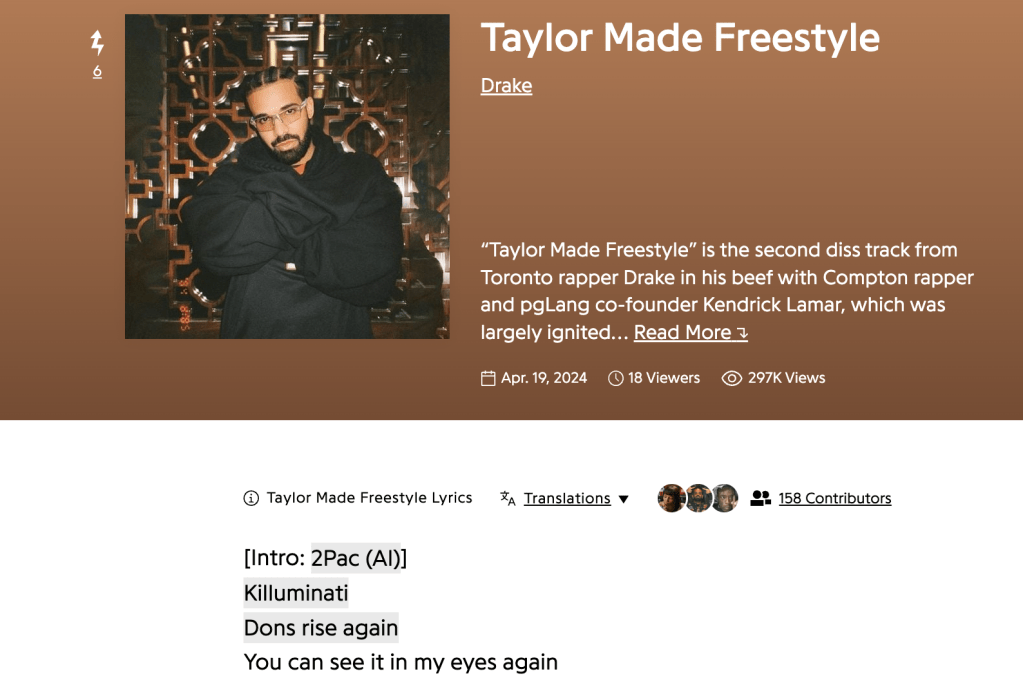
Taylor Made Freestyle

Drake and Kendrick Lamar have been slinging disses back and forth in their recent releases and Taylor Made Freestyle is Drake’s latest response.
The most controversial aspect of the track was the use of AI voice cloning to incorporate verses from Tupac and Snoop Dogg with the bulk of the criticism centering around what was suspected to be unauthorized use of the deceased Tupac’s likeness – the track begins with Tupac’s voice rapping a verse goading Kendrick to respond. A week later, these suspicions were confirmed with Tupac’s estate filing a cease and desist against Drake to take down the track.

Drake is intimately familiar with AI generated content having been voice cloned on a viral TikTok track Heart on My Sleeve last spring. The notable difference this time is that he, with his widely recognizable brand and access to broad distribution, is the one certifying a track that prominently uses AI generated content. While it can be argued that the creation of Heart on My Sleeve likely involved a mix of AI generation and non-trivial human effort, it was easier for the public to simply categorize the track as AI generated in the absence of a prominent human with a known brand to anchor to. With Taylor Made Freestyle, not only is the mix of AI generation and non-trivial human effort more recognizable when listening to the track (Drake himself raps one of the verses), but the face of the track is also that of one of biggest music artists in the world. In this case, should we be categorizing the track as AI generated if two out of three of the verses were created using AI? Is a binary categorization of content as AI generated vs. human generated even useful here?

AI generated samples everywhere

The story of the music industry, and the hip hop genre in particular, is a story of sampling – the process of incorporating parts of existing songs into new songs. It only takes a few minutes of browsing on WhoSampled to see how much new music is built on a composition and remix of past music. Samples are everywhere!
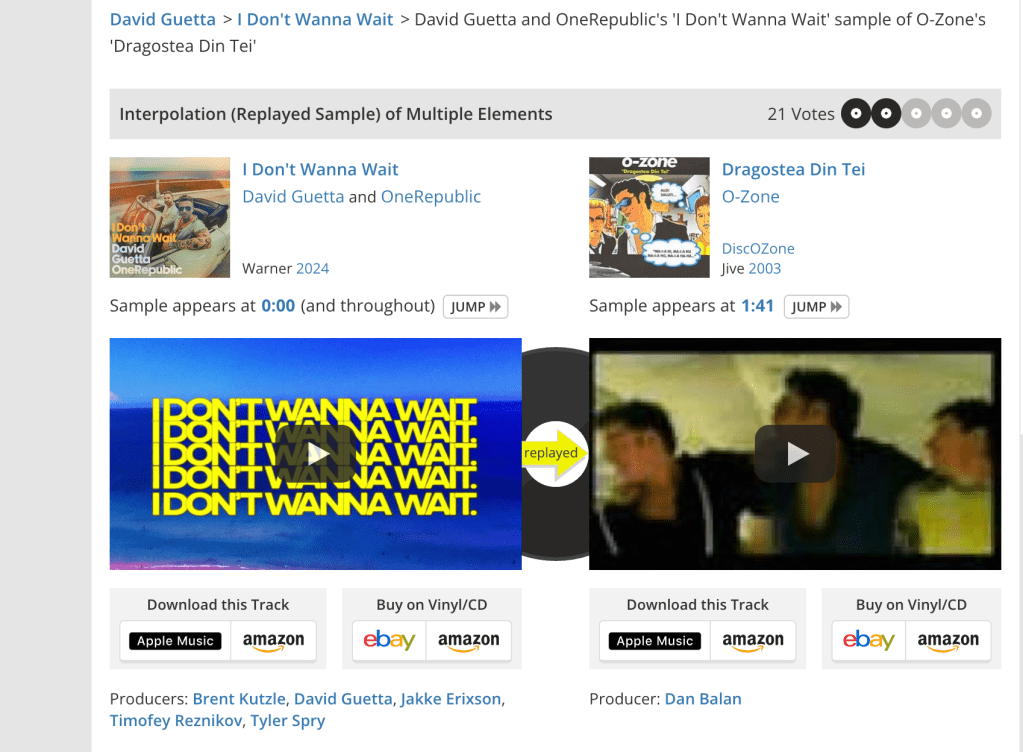
The best use of this sample is still Numa Numa

Taylor Made Freestyle shows how sampling could evolve in a world of generative AI. Instead of incorporating samples from fixed source music, the track incorporates samples dynamically generated by AI in the style and likeness of specific artists. The use of AI in the sample generation process can be viewed as the next evolution of audio filters and edits applied in a production studio. Artists started off by playing with reverb and distortion, then they dabbled with autotune to alter pitch, and now they are using generative AI to manipulate timbre to convert any sound into their instrument and voice of choice. The first verse of Taylor Made might be rapped by AI Tupac, but converting the verse to use Drake’s voice is just a tweak away in the studio.

If AI generated samples are the next evolution of sampling, we can expect a large portion of songs in the future to contain AI generated samples. Nate Raw compares this future of music with the ChatGPT-ification of text on the Internet – just as traces of ChatGPT can already be found in everything from press releases to blog posts (drink for every instance of “delve” that you see online today), traces of AI will be found in everything from hip hop diss tracks to EDM festival anthems.

Made with AI labels

The likely proliferation of AI generated samples should be kept in mind when considering Meta’s plans to start adding “Made with AI” labels on its platforms (i.e. Facebook, Instagram, Threads) starting in May.
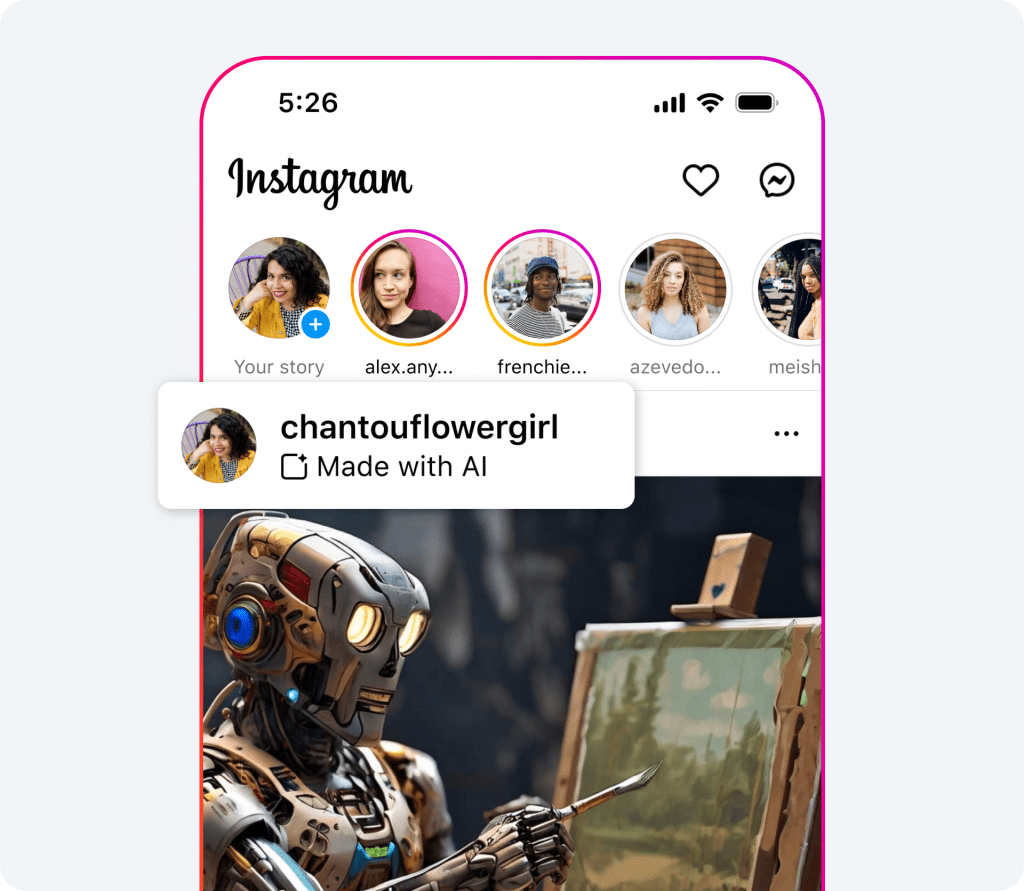
Source

The rollout of Made with AI labels is largely motivated by pressure to establish defensive measures against misinformation driven by photorealistic AI deepfakes during the 2024 election season. The system is likely to undergo plenty of iteration over time, but as-is it already highlights some of the challenges in deploying defensive measures against negative uses of generative AI without stymieing experimentation with positive uses.

Does “Made with AI” mean that the content was entirely generated using AI? Or does it mean that the content includes some AI generated portions? If the intent is for the label to convey latter, will consumers interpret the label in that manner or will they still interpret the label as the former? This last question is particularly important because there is clearly a difference in an image generated via Midjourney and that same image used as a canvas for an artist to overlay additional aesthetic edits with other tools. Similarly, there is also clearly a difference between a purely AI generated song from Suno vs. a song that is the composition of AI generated samples and human generated sounds. All of these examples can be categorized as content with AI generated portions. But, if all of these examples are labeled as “Made with AI” and consumers end up interpreting the label as an indication that the content was entirely generated using AI then artists that incorporate AI in a larger creative process would be lumped in with a sea of other commoditized AI outputs in the eyes of the consumer. Furthermore, a “Made with AI” label will lose utility as traces of AI make their way into the majority of content – the label probably won’t be very useful if most content has it.

All that said, another Meta press release hints at a future direction that could be more productive:

While the industry works towards this capability, we’re adding a feature for people to disclose when they share AI-generated video or audio so we can add a label to it. We’ll require people to use this disclosure and label tool when they post organic content with a photorealistic video or realistic-sounding audio that was digitally created or altered, and we may apply penalties if they fail to do so.

Setting aside the contents of the label for a moment, the most interesting aspect of this approach is that it would create an incentive for creators to make transparent assertions about the provenance of their content and only applies penalties if those assertions are found to be false. The use of AI is certainly an important assertion to include, but ultimately what is most important is to ensure consumers have sufficient context based on content provenance. This context can help mitigate misinformation if the consumer, as an example, knows that the content originated from a camera at a specific time and place and not an AI image generation tool. This context could also help content using AI generated samples stand out in a sea of commoditized AI outputs if the consumer, as an example, knows that the content originated from a novel workflow that combines AI and human efforts.

There are plenty of open questions and challenges here. Can the friction involved in making these assertions be reduced and automated? Is there a UI that can surface this information in a way that meaningfully influences consumer behavior? Meta suggested penalizing inaccurate assertions of provenance – is it possible to also create an ecosystem that rewards accurate assertions of provenance from both the creator and others? But, relative to the binary categorization of content as AI generated vs. human generated which feels too reductive and constraining, this seems to be a more promising direction to explore for fostering a dynamic ecosystem of creative content while minimizing the harm of AI powered misinformation.

What C2PA does and does not solve

Along with questions from an initial dive into the 2.0 spec.

This essay and all new writing is also published in my newsletter which you can sign up for here.

We’re just a few months into 2024 and there does not appear to be any sign of slow down in generative AI advancements with the quality of synthetic media increasing every day across all modalities. As election seasons progress throughout the world, we can expect to see an uptick of synthetic deepfakes making their rounds online and with it increased concerns of how to distinguish between physical and AI generated realities.

In the past few months, C2PA, touted as a technical standard for establishing the provenance of digital media, has received increased attention as a potential solution with a number of tech companies including Meta, Google and OpenAI shipping integrations or announcing plans to do so. Adobe has been leading the charge promoting the use of Content Credentials, built using C2PA, as “nutrition labels” that can be used by consumers to understand the provenance of media and most importantly distinguish between real media and AI generated deepfakes. At the same time, the approach has been criticized for being too easily bypassed by bad actors and insufficient for proving provenance.

As the standard is evaluated and adopted, it is worthwhile asking: what are the exact problems that the C2PA standard actually solves for and what does it not solve for?

What is C2PA?

From the C2PA website:

The Coalition for Content Provenance and Authenticity (C2PA) addresses the prevalence of misleading information online through the development of technical standards for certifying the source and history (or provenance) of media content.

From the C2PA spec:

This specification describes the technical aspects of the C2PA architecture; a model for storing and accessing cryptographically verifiable information whose trustworthiness can be assessed based on a defined trust model. Included in this document is information about how to create and process a C2PA Manifest and its components, including the use of digital signature technology for enabling tamper-evidence as well as establishing trust.

My simplified explanation of C2PA in a single sentence:

C2PA is a standard for digitally signing provenance claims about a media asset (i.e. image, video, audio, etc.) such that any application implementing the standard can verify that a specific identity certified the claim.

A claim consists of a list of assertions about an asset which can include:

  • The creator’s identity
  • The creation tool (i.e. camera, Adobe Photoshop, OpenAI’s DALL-E 3)
  • The time of creation
  • The “ingredient” assets used and actions performed on them during creation

A key property of C2PA is that a claim is directly tied to an asset and can travel with the asset regardless of where the asset is used whether it be on a social media platform (i.e. Facebook, Instagram) or a chat application (i.e. Whatsapp).

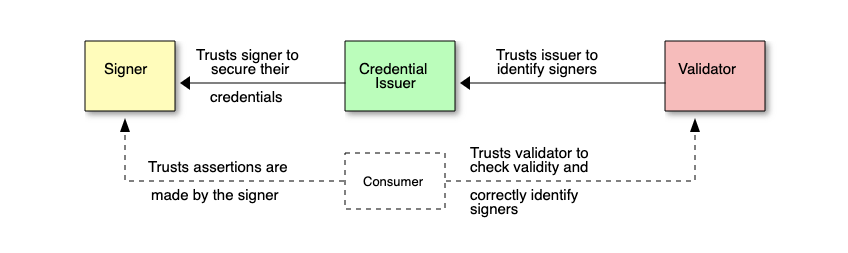
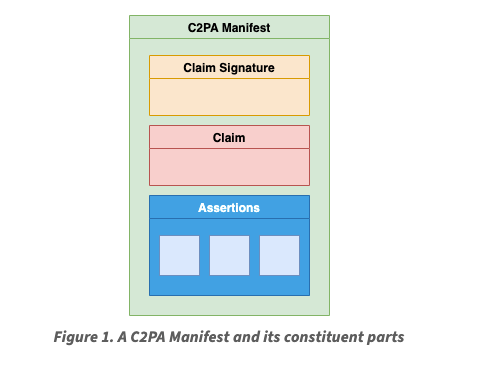
A claim is digitally signed by the hardware or software used to create the asset. The signature and claim are then packaged up into a manifest file that can be embedded into the asset and/or stored separately for later retrieval. An application can then fetch the manifest for an asset, verify the signer and evaluate the trustworthiness of the signer based on the requirements of the application. For example, Adobe’s Content Credentials Verify tool checks uploaded assets for a manifest and if the application trusts the signer the UI will display a Content Credentials badge.

But, how would an application know if the assertions in a claim are actually correct and that an asset was actually created using, for example, a camera and not a generative AI model? The short answer is that an application wouldn’t – the C2PA manifest for an asset alone is insufficient to guarantee that claim’s assertions are correct. So, what’s the point of a signed provenance claim if we can’t guarantee that its assertions are true?

Note: A C2PA workflow can provide stronger guarantees around the correctness of certain assertions, such as the creation tool, if a claim is signed by hardware with a secure enclave. In 2023, Leica released a camera with C2PA signing support which would allow the camera itself to sign a claim asserting that the specific camera model was used to take a photo. However, since hardware with C2PA signing support is not widely deployed as of early 2024, the rest of this post will focus instead on scenarios where claims are signed by software.

What does C2PA not solve for?

The trust model defined in the C2PA spec explicitly states that a consumer (both the human and an agent acting on behalf of the human) is able to verify the identity of the signer for a claim, but must decide on their own whether the claim’s assertions are correct using the signer’s identity and any other available information as evidence. Given this, the criticism that the use of C2PA alone would be unable to actually establish irrefutable provenance of an asset is fair – you cannot guarantee that a provenance claim for an asset accurately represents the asset’s provenance just based on signature verification alone.

What does C2PA solve for?

The problem that C2PA actually solves for is establishing non-repudiable attribution for provenance claims about a media asset in an interoperable manner. The claim signature links the claim to a specific identity which establishes attribution and non-repudiation – anyone can verify that the identity made the claim and not someone else. The standardized data model for the manifest that packages up a claim and its signature allows any application supporting the standard to process a claim and attribute it to an identity which establishes interoperability.

Is all of this still useful if the claim may not represent the asset’s true provenance? I would argue yes.

Today, as an asset is shared and re-shared across different platforms, the authentic context for the asset is lost.

Consider the following scenario: a photo taken from country A could be published by a news organization on social media and then copied and re-shared across accounts and platforms such that a consumer is misled by a third party to believe that the re-shared photo shows an event happening in the conflict zone of country B.

When the news organization publishes the photo they are making a claim that the photo was taken at a specific time and place. The claim is a part of the authentic context defined by the news organization. The problem is that this context is lost as the photo travels around the Internet making it more difficult for a consumer to determine who the photo was originally published by and allowing others to make claims about the photo that sow confusion.

A signed claim would not irrefutably prove that the photo was taken at a certain time and place, but it would preserve the authentic context for the photo – it would preserve the claim that the news organization made about the photo’s provenance. Consumers would still have to judge for themselves whether they trust the news organization’s claim, but they would know for certain who the photo was originally published by and that the claim was made by the news organization and no one else which keeps the news organization accountable for their claims.

Issues to address

A few issues come to mind that are worth addressing:

Many platforms strip metadata, which would include C2PA manifests, from uploaded media assets

Potential solutions to explore:

  • Platforms can retain manifests for uploaded assets
  • Publishers can store manifests in a public registry such that they can be looked up for assets even if platforms strip the manifest for uploaded assets

Bad actors can strip the C2PA manifest before uploading an asset

Potential solutions to explore:

  • Platforms can start flagging assets without manifests and/or prefer assets with manifests in algorithmic feeds

The challenge here is that most assets will not have manifests initially similar to how most websites did not have SSL certificates during the early days of the HTTP -> HTTPS transition so before this becomes a viable approach it will need to be much easier for publishing tools to create manifests. The more aggressive warnings shown by browsers for websites without SSL certificates were enabled in large part by services like Let’s Encrypt dramatically reducing the friction in obtaining a SSL certificate.

Bad actors can create their own C2PA manifest with incorrect assertions for an asset

Potential solutions to explore:

  • Platforms can use trust lists and scoring to evaluate whether the signer should be trusted in a specific context

Questions

A few questions I am thinking about:

How will the C2PA trust list that initial validator implementations will use by default be decided?

The current version of the C2PA spec uses a PKI based on x509 certificates. A claim signer must have a signing certificate and a validator will check that the signing certificate fulfills one of the following conditions:

  • The signing certificate can be linked back through a chain of signatures to a root Certificate Authority (CA) certificate that is on the default C2PA list of trusted CAs
  • The signing certificate can be linked back through a chain of signatures to a root CA certificate that is on the validator’s custom list of trusted CAs
  • The signing certificate is on the validator’s custom list of trusted signing certificates

The members of the default C2PA trust list will have a lot of power because claims signed by signing certificates that they issue will be trusted by default by any C2PA software.

How will major content distribution platforms (i.e. Facebook, Instagram, etc.) with C2PA validator integrations decide on the trust anchors to add to their trust list?

The platforms will be able to customize their trust lists and specify additional CAs (and possibly ignore CAs on the C2PA trust list?) that they trust. But, in practice, will they just use the default C2PA trust list?

How will creator tools get signing certificates that are accepted by validators?

Will developers have to go through a manual approval process? Will this go through a small number of CAs or will there be many CAs that issue different types of certificates that reflect the type of validation performed similar to Domain Validated vs. Organization Validated SSL certificates? Will automated services be possible similar to what Let’s Encrypt did for SSL certificate issuance?

The claim signer is expected to be the hardware or software used to create an asset and not the creator themselves. In certain cases, could it make sense for the claim signer to be the creator themselves?

The Creator Assertions Working Group (CAWG) is working on standardizing how a creator can create a signed assertion documenting themselves as the asset creator in a C2PA claim. But, this results in an additional signature separate from the claim signature. The intent seems to be for the hardware or software based claim signer to verify this identity assertion before including it in the claim. This workflow makes sense in the scenarios where the hardware or software is not completely controlled by the creator i.e. a camera with a secure enclave, a backend service for a web application. However, this workflow makes less sense for non-hardware, locally run creator tools (applies to many open source tools) without a backend that can secure a private key for signing. In this scenario, since the creator is in complete control of the tool, it seems like it would make more sense for the claim signer to just be the creator rather than having a separate claim signature and an identity assertion – who else would produce the claim signature besides the creator?

Can identity assertions preserve privacy?

The CAWG seems to be exploring the use of privacy preserving techniques for future versions of the spec that are compatible with WC3 Verifiable Credentials. There is also interesting in the wild work happening in other communities that seems worthwhile to consider learning from. The 0xPARC community has established its own Proof Carrying Data (PCD) framework that uses ZKPs to create and compose privacy preserving claims about an identity – perhaps there is an opportunity to leverage some that work here.

How will content optimization pipelines that alter the hash of data without altering visual content (i.e. image rendering, video transcoding, etc.) be affected by C2PA adoption?

The C2PA spec allows service providers to create their own signed claims with assertions about the computation performed on an input asset which is referenced in the manifest. However, this would require service providers to implement C2PA support which likely would only happen if they are pressured by platforms to do so. A platform might just show users an optimized version of an asset with a hash that does not match the one in a C2PA manifest. The argument in defense of this practice would be that the user is trusting the platform anyway and the platform knows that the optimized asset it is showing users visually corresponds to the one referenced by the hash in the manifest.

How should we think about C2PA vs. NFT standards like ERC-721?

While C2PA and NFT standards both have a design goal of establishing attribution for provenance claims in an interoperable manner, they also differ in a number of ways:

  • The C2PA spec is focused on standardizing how to make assertions about the lifecycle of a media asset while most NFT standards are more generic with their treatment of asset metadata.
  • The C2PA spec optionally allows manifests to be timestamped by centralized Time Stamp Authorities while NFT standards assume that metadata is timestamped by a blockchain.
  • A C2PA manifest records a provenance claim while a NFT records a provenance claim and links it with a transferrable/tradeable asset.

At this point, C2PA and NFT standards appear to be more likely to be complements as opposed to substitutes.

Can C2PA adoption benefit from the consumer crypto wallet infrastructure that has been deployed in the past few years?

In order for creators to create identity assertions for C2PA claims, they will need consumer friendly software for signing. While there are still a number of UX/UI improvements that need to be made, the consumer wallet software that the crypto industry has funded in the past few years arguably represents the most sophisticated deployment of consumer digital signing software out in the wild.